10 Best 3D Print Filaments for Every Project
Choosing a 3d Print Filament is not just a color decision. It affects strength, surface finish, heat resistance, print difficulty, and cost. The Wohlers Report 2024 estimated that the global additive manufacturing industry reached $20.0 billion in 2023, growing 11.1% year over year. That expansion brings more material choices, but also more room for mismatched expectations. A glossy spool may look ideal; its print settings and performance still matter.
Dr. Joshua Pearce, a researcher in open-source 3D printing, has described the technology as having the potential to “democratize production.” That promise depends, in part, on practical material choices. PLA often suits clean indoor prototypes and decorative models. PETG can handle tougher everyday parts, while ABS and ASA generally need more attention to ventilation and printer setup. Nylon and flexible filaments bring different challenges again. These are useful starting points, not guarantees. Printer design, storage, nozzle temperature, and part geometry can change the result.
This guide compares ten widely used filament types across real project needs: appearance, durability, flexibility, ease of printing, and common trade-offs. Expect concrete examples, from a small desk organizer to a clip that must flex repeatedly. No filament wins every job. The best choice is the one that meets the part’s demands without adding unnecessary complexity. And sometimes, the first choice will be wrong. That is worth admitting.
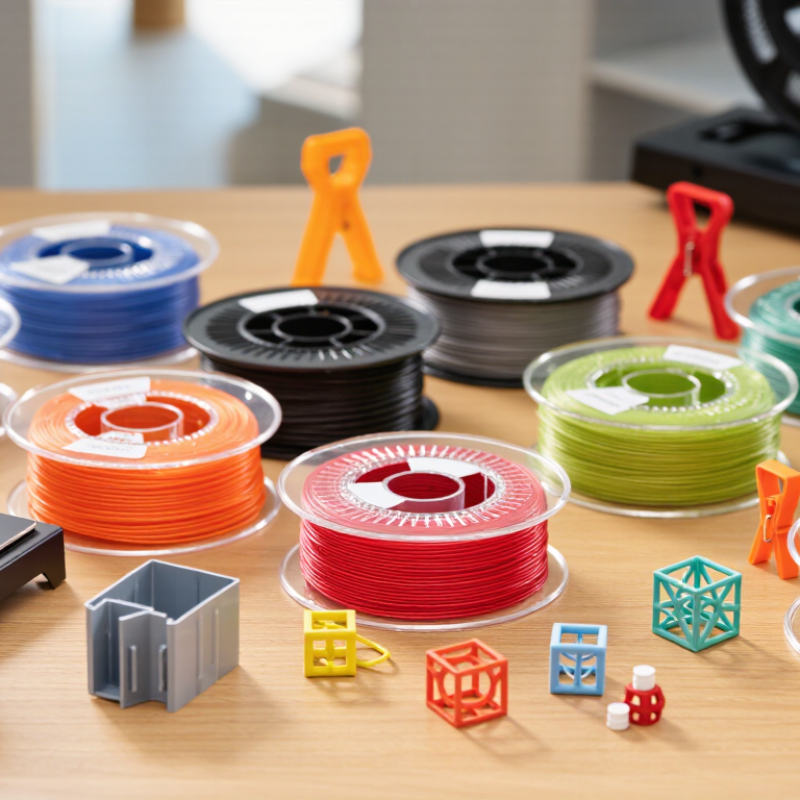
How 3D Printing Filaments Differ in Material and Performance
Choosing among ten popular filaments means balancing printability, strength, heat resistance, and flexibility. PLA is stiff and easy to print, making it useful for display models and prototypes. Easy to print. PETG tolerates impacts and moisture better, though strings may cling between travel moves. ABS and ASA handle higher temperatures; both can warp, and printing them calls for good ventilation. That matters.
TPU bends instead of snapping, so it suits grips and flexible covers. Nylon resists wear, but it absorbs moisture from the air and may print poorly when damp. Polycarbonate can offer high strength and heat resistance, yet it usually demands careful temperature control. PVA dissolves in water and works as a support material for complex shapes. HIPS can also support overhangs and can be removed with a compatible solvent. Carbon-fiber-filled filament is stiffer, but its fibers can wear a standard nozzle. Not always worth it.
Material names alone do not guarantee performance. Wall thickness, layer direction, nozzle temperature, and cooling all change the result. A small test print can reveal warping, brittle layers, or unwanted flex before a full-sized part is underway. I still find one trade-off easy to misjudge: a strong filament may be difficult to print consistently. Check the printer’s temperature limits and the part’s actual working conditions before choosing.
What to Consider When Choosing a Filament for Your Project
Choosing a filament starts with the part’s job, not its color. Will it flex, carry a load, touch warm surfaces, or sit on a shelf? PLA is often convenient for detailed indoor models, but can soften in heat. PETG often suits tougher functional parts, though it can string and needs dry storage. Fit matters.
Check your printer’s limits before buying filament. The hotend must reach the required temperature, and the build surface must support reliable adhesion. A part curling at the corners may point to a settings issue, not a bad material. Still, a drafty room can make warping worse, especially with materials that benefit from an enclosure. For flexible filament, confirm the feed path handles soft material, and print more slowly. Nylon absorbs moisture from the air; dry it before judging print quality. Moisture matters, too.
Think about the finished surface and tolerances. A snug clip may need a small clearance adjustment, while visible layer lines can be reduced with finer layers. Test a small sample first. Record the temperature, speed, and results, but change one setting at a time. Even a sensible first choice can disappoint; a test piece is where assumptions show.
Ten Popular Filaments and the Projects They Suit Best
Filament choice should follow the part’s job, not a strength ranking.
PLA suits quick-fit models, desk organizers, and decorative pieces; it prints easily but can soften in a hot car.
PETG handles plant pots and workshop brackets where moisture resistance helps.
ABS fits indoor enclosures and functional parts, though it can warp and needs good ventilation.
ASA is a better pick for outdoor housings exposed to sun and weather.
TPU makes flexible phone cases, feet, and protective bumpers.
Keep it dry. Wet filament can leave rough surfaces and weak layers.
Nylon suits gears and hinges that face repeated movement, but absorbs moisture readily.
Polycarbonate works for rigid, heat-tolerant guards, provided the printer can maintain high temperatures.
Polypropylene suits lightweight containers and living hinges; adhesion can be difficult.
PVA is a water-soluble support for complex models, while HIPS can support ABS prints and later dissolve in compatible solvent.
Trade-offs matter. Wohlers Report 2024 estimated the global additive manufacturing industry reached $20.035 billion in 2023, up 11.1% from 2022. That figure covers the wider industry, not filament sales alone.
Material performance still depends on print settings, part design, and real-world testing. I would test a small sample before trusting a costly or load-bearing part.
How to Store and Print Filaments for Reliable Results
A reliable print often starts before the nozzle warms. Wohlers Associates’ Wohlers Report 2024 estimated that the global additive manufacturing industry reached $20.0 billion in 2023. As use grows, repeatable material handling matters. Store opened spools in sealed bags or airtight containers with fresh desiccant. Keep them away from sunlight, heaters, and damp rooms. Label each spool with its material and opening date. Small habits matter.
Moisture can cause popping sounds, rough surfaces, weak layer bonding, and fine strings. Dry filament only at the temperature and duration recommended for that material; excessive heat can deform a spool or filament. A dry box helps during printing, especially in humid conditions. Check the first layers, listen for crackling, and inspect a short test print before starting a long job. Not every defect comes from wet filament. A clogged nozzle or poor bed adhesion can look similar.
Tips: Use a sealed container, not an open shelf. Add desiccant, then check its indicator or replace it regularly. One caveat: a container cannot dry filament that is already wet. If results remain inconsistent, record the spool, drying time, room conditions, and print settings. It feels fussy. It saves reprints.
10 Best 3D Print Filaments for Every Project
Typical nozzle temperature ranges for reliable printing (°C)
These ranges are common starting points; the ideal settings vary by filament formulation and printer, so check the spool’s recommendations and calibrate with a test print. For more consistent results, keep moisture-sensitive filaments sealed with desiccant and dry them according to their manufacturer’s guidance.
