How to Choose the Best Electronic Circuit Board for Your Needs?
Choosing the right electronic circuit board can be challenging. The variety of options available can overwhelm many. Industry expert Dr. Sarah Thompson emphasizes, "Quality and specifications are crucial in selecting an electronic circuit board." Her experience in the electronics sector underlines the importance of making informed choices.
When evaluating your needs, consider your project requirements. Different applications demand different specifications, materials, and designs. A thorough understanding of these factors is necessary. For instance, high-frequency applications need boards that can handle specific signal integrity. Failing to choose correctly might lead to poor performance.
Furthermore, always assess the manufacturer’s reputation. Look for reliable suppliers known for producing durable electronic circuit boards. Check reviews and feedback from previous customers. This step minimizes potential risks and enhances the decision-making process. Make the right choice, and your project’s success could depend on it.

Understanding Your Project Requirements for Circuit Boards
When choosing a circuit board, clearly understanding your project requirements is essential. Each project has unique needs.
Consider the size, complexity, and purpose of your board. Some projects may require a compact design, while others need more space for components.
Analyze the environment where your circuit will operate. Will it be exposed to moisture or heat? This factor directly influences material selection.
Evaluate the number of layers needed for your circuit board. More layers often improve performance but can increase costs.
Conduct thorough research on the intended electronic application. Are you developing a prototype or a final product?
Prototypes often require flexibility in design, while final products demand durability and reliability.
Anticipate future changes as well. Projects can evolve, and your board should accommodate potential upgrades or modifications.
While brainstorming your requirements, it's crucial to question your assumptions. Do not overlook potential challenges.
For instance, complex designs may lead to higher failure rates. A simple design can sometimes be more effective.
Engage with experts, but remember that their advice may not always align with your vision.
Reflect on how your unique circumstances shape your decisions, allowing room for adjustments.
Types of Electronic Circuit Boards and Their Applications
When selecting an electronic circuit board, understanding the various types available is crucial. There are several common types: printed circuit boards (PCBs), flexible circuit boards, and rigid-flex boards. PCBs are widely used in consumer electronics, with an estimated market share of about 40% in the electronics industry, according to recent industry reports. Their versatility makes them suitable for various applications, from smartphones to industrial machinery.
Flexible circuit boards, valued for their lightweight and adaptable nature, are ideal for applications in medical devices and wearables. With the global flexible PCB market projected to grow at a CAGR of 9.8% until 2028, their demand is clearly rising. Rigid-flex boards combine the benefits of both rigid and flexible designs. They allow for complex circuits in compact spaces, often used in aerospace and military applications.
Choosing the right type of circuit board can pose challenges. Factors such as design complexity, environmental conditions, and cost should be evaluated. Many engineers note that overlooking these elements can lead to issues like signal integrity and performance failures. Being aware of the distinct advantages and limitations of each type can ultimately guide more informed decisions. Crafting a tailored design may require iterative testing and refinement, presenting opportunities for learning and improvement.
How to Choose the Best Electronic Circuit Board for Your Needs?
| Type of Circuit Board |
Material |
Typical Applications |
Advantages |
Disadvantages |
| Single-Sided PCB |
FR-4 |
Consumer Electronics, Simple Circuit Applications |
Cost-effective, Easy to manufacture |
Limited space for wiring components |
| Double-Sided PCB |
FR-4, Polyimide |
More Complex Circuits, Industrial Equipment |
More components can fit, Better performance |
More expensive than single-sided |
| Multilayer PCB |
FR-4, Rogers |
High-Density Interconnect (HDI), Medical Devices |
Very compact, Excellent signal integrity |
Complex design process, High cost |
| Flexible PCB |
Polyimide |
Wearable Technology, Aerospace |
Lightweight, Can be bent/shaped |
More fragile than rigid boards |
| Rigid-Flex PCB |
FR-4, Polyimide |
Mobile Devices, High-Performance Applications |
Combines rigidity and flexibility, Saves space |
More complex and costly to manufacture |
Key Specifications to Consider When Choosing a Circuit Board
Choosing the right electronic circuit board requires careful consideration of several key specifications. One important aspect is the size and shape. Ensure it fits your project layout. A compact design may work well for small devices, while larger boards may handle more complex circuitry. Think about your specific space requirements.
Another critical factor is the material used. Common options include FR-4, which is known for its durability and cost-effectiveness. However, some projects may need higher heat resistance or flexibility, prompting the use of alternative materials. Reflect on your project's operational environment to select the most suitable option.
Moreover, pay attention to the number of layers. Single-layer boards are simpler and cheaper, but multi-layer boards can accommodate complex designs. Assess the functionality you need. More layers can improve performance but may also increase costs. It's essential to balance your budget with your project's technical requirements.
Material Options for Circuit Boards and Their Impact on Performance
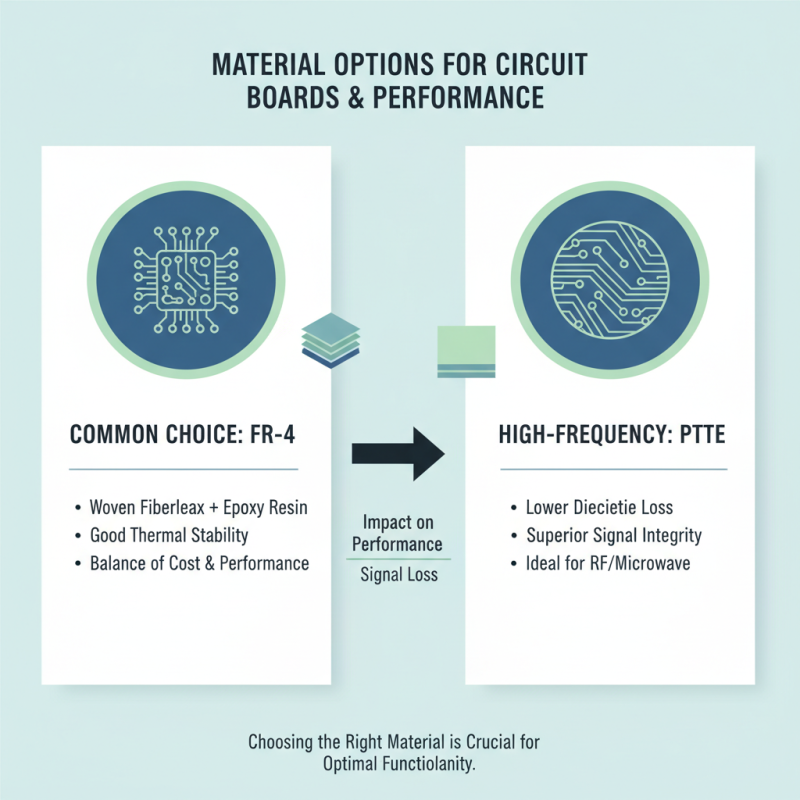
When selecting an electronic circuit board, the material plays a crucial role. Different materials offer varying performance characteristics that can significantly affect the board's functionality. For instance, FR-4 is a common choice for its balance of performance and cost. It is made of woven fiberglass and epoxy resin, providing good thermal stability. However, for high-frequency applications, alternatives like PTFE may be more suitable, as they exhibit lower dielectric loss.
Another aspect to consider is the environmental conditions. If your circuit board will face moisture, materials with protective coatings are vital. These coatings can improve longevity and performance in humid conditions. Additionally, the choice of copper thickness impacts conductivity and heat dissipation. Thicker copper enhances power handling but can also contribute to weight.
Evaluating material options requires careful consideration of your specific needs. Conducting thorough research helps, but real-world testing is essential. You might find that the chosen material does not perform as expected. Adjustments may be necessary, highlighting the importance of a flexible approach. Getting the right material can elevate your project, but it also demands ongoing reflection and reevaluation.
Evaluating Costs and Suppliers for Your Circuit Board Needs
Evaluating costs and suppliers for your circuit board needs requires careful consideration. Begin by assessing your project requirements. Determine the complexity of the design and the expected performance. Complexity affects the cost significantly. More layers and intricate designs usually lead to higher prices.
Next, research potential suppliers. Visit their websites to understand their capabilities. Look for reviews and testimonials. Check their certifications to ensure reliability. Don’t hesitate to contact them for quotes. This step can reveal variations in pricing. However, be cautious of extremely low prices; they may indicate compromised quality.
Finally, consider order quantities. Bulk orders can lower the unit cost, but ensure you won't overorder. Analyzing lead times is equally important. Suppliers with fast turnaround might charge a premium. Balance cost-saving with time efficiency. Reflect on these aspects because a poorly chosen supplier could derail your project.