Why Choose Quartz Wristwatches for Your Business?

Quartz Wristwatches can give businesses a practical way to serve customers seeking dependable timekeeping, accessible prices, and varied designs. Their battery-powered movements generally require less routine adjustment than mechanical movements. For a retailer, that can mean simpler product explanations and a clear entry point beside higher-priced watches. A clean steel case, readable dial, and reliable quartz movement may suit everyday buyers better than a complicated feature set. The details still matter: battery replacement, water-resistance claims, warranty terms, and supplier support should be checked before placing an order.

Industry data offers useful context, though it does not prove demand for quartz specifically. The Federation of the Swiss Watch Industry reported that Swiss watch exports reached CHF 26.0 billion in 2024, while export volumes fell by 9.4% from the previous year. Those figures cover Swiss watches overall, not the global quartz market. Still, they highlight a business reality: value and unit volume can move in different directions. Retailers should assess their own customers, margins, and stock turnover rather than treat headline export figures as a sales forecast. Deloitte’s Swiss Watch Industry Study can add market context, but it also focuses on the Swiss watch sector, not every quartz supplier or retail channel.

That matters. Quartz Wristwatches may offer a focused, practical category for businesses building an accessible assortment. Yet low maintenance alone does not guarantee strong sales. Customer feedback, dependable sourcing, and honest product specifications make the stronger case.
Why Choose Quartz Wristwatches for Your Business?

Understanding How Quartz Wristwatches Work

A quartz wristwatch converts electrical energy into regular motion. Its battery sends a small current through a quartz crystal, which vibrates at a stable frequency. In many watches, that frequency is 32,768 vibrations per second. The circuit divides the signal until it produces one pulse each second. A tiny motor then moves the hands, often with a distinct one-second tick. It is precise engineering in a small case.

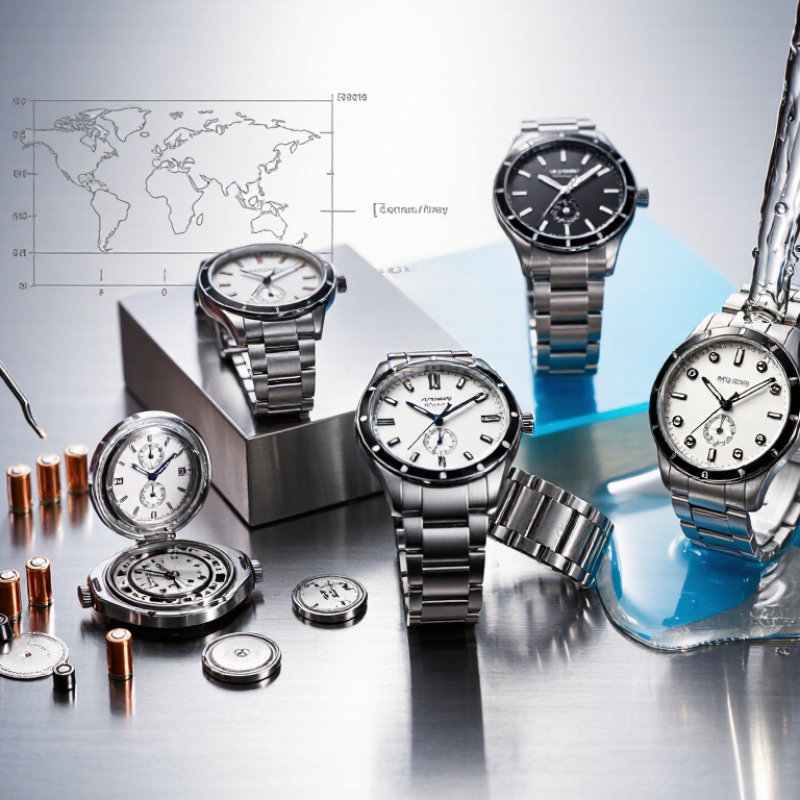
For a business, this mechanism can mean predictable timekeeping and straightforward servicing across a product range. The Federation of the Swiss Watch Industry reported 16.9 million Swiss watches exported in 2023, across both quartz and mechanical categories. That figure indicates significant unit movement, though it does not measure global demand or quartz sales alone. Still, quartz is not maintenance-free: batteries need replacing, and performance can vary with temperature and component quality. A display case also makes the practical details visible: battery access, hand alignment, and a clear second-hand step. Small things matter. A quartz model may suit customers who value everyday reliability, but its movement alone does not guarantee quality; materials and assembly matter too.

Matching Quartz Watches to Your Business Needs

Why Choose Quartz Wristwatches for Your Business?
Matching Quartz Watches to Your Business Needs

Quartz watches suit businesses that need reliable timekeeping, predictable costs, and simple upkeep. Match the watch to its setting: a slim, clear-dial model works well for client meetings, while a water-resistant case may better serve active field teams. Consider staff roles, uniform colors, wrist sizes, and whether watches are daily tools or employee gifts. Small details matter. A heavy case can feel uncomfortable after a full shift.

Grand View Research estimated the global watch market at about US$75.8 billion in 2023 and projected 5.6% annual growth through 2030. This estimate covers the broader watch market, not quartz watches alone, so it should not be treated as a quartz-specific demand forecast. For purchasing, compare total cost, battery replacement access, warranty terms, and minimum order quantities. A low unit price can lose its appeal if servicing is difficult.

Tips: Request samples before ordering. Check the dial under office lighting, test the clasp, and confirm engraving space. Ask suppliers for written specifications and lead times. I would still leave room for employee feedback; practical preferences can surprise you.

Why Choose Quartz Wristwatches for Your Business? - Matching Quartz Watches to Your Business Needs

Business Need Why Quartz May Be a Good Fit Typical Considerations Best Match
Uniforms and staff timekeeping Quartz watches generally keep time reliably and do not need daily winding, making them practical for routine wear. Accuracy varies by movement; ordinary quartz models commonly specify accuracy within about ±15 seconds per month. Check the individual watch specification. Simple, legible analog or digital models with durable straps
Bulk purchasing and controlled budgets Quartz watches are available across a wide range of price points, which can make it easier to select models for different roles and budgets. Compare total ownership costs, including batteries, servicing, warranty terms, and replacement straps—not just the purchase price. Standard models with readily available batteries and parts
Gifts, awards, and employee recognition A wristwatch is a useful, portable gift that can suit many professional settings. Choose a broadly wearable design and confirm that any personalization is compatible with the case material and warranty. Classic designs with clear dials and comfortable sizing
Fieldwork and active jobs Quartz options include lightweight digital watches and models with practical features such as alarms, timers, or backlights. Water resistance and impact resistance depend on the specific construction. Water-resistance ratings do not mean a watch is suitable for every water activity. Models with the required functions and a rating suited to the working environment
Low day-to-day upkeep Most battery-powered quartz watches run without winding. Many conventional models need a battery replacement roughly every 1–3 years, though battery life varies. Some models use rechargeable or solar charging, while others have different battery intervals. Follow the manufacturer’s care guidance. Battery-powered models for straightforward use; solar quartz where regular light exposure is practical
Roles requiring precise scheduling Quartz regulation is generally consistent for everyday timekeeping and is not affected by the wearer’s daily winding routine. Temperature, movement design, battery condition, and other factors can affect accuracy. Avoid assuming every quartz watch has the same specification. A model whose stated accuracy meets the role’s requirements
Business travel across time zones Some quartz watches offer dual-time displays or easy time-zone adjustment, which can help frequent travelers. These features are model-specific; check that the display and adjustment method are easy for the intended users. Dual-time or world-time models for employees who travel often

Figures are typical guidance, not guarantees. Actual accuracy, battery life, water resistance, durability, and maintenance requirements vary by model and use; consult the product specifications before purchasing.

Evaluating Accuracy, Durability, and Maintenance Costs

Quartz movements suit business stock when dependable timekeeping matters more than mechanical appeal. Many standard movements are rated to stay within roughly 15 seconds per month, though results vary with movement quality, temperature, and battery condition. Check the stated tolerance rather than assuming every quartz watch performs alike. For staff schedules or customer-facing displays, small time differences can become noticeable over several weeks. Test a sample.

Durability depends less on the word quartz than on the case, crystal, crown, and water-resistance rating. Mineral crystal usually costs less, while sapphire generally resists scratches better; neither makes a watch damage-proof. Ask how water resistance is tested, and do not treat a rating as permission for every activity. Maintenance is usually simple: replace the battery, inspect seals, and check the watch after impacts or moisture exposure. Battery life varies, often lasting one to several years, so include labor, shipping, and downtime in cost estimates. Those costs add up. Low-cost battery changes may seem economical, but poor replacement work can compromise seals. Compare service access and spare-part availability before ordering in volume; this detail is easy to overlook.

Choosing Styles and Features for Your Brand

Quartz wristwatches give businesses a practical canvas for expressing a brand, but the design should suit the people who will wear it. A clean three-hand dial may fit an office setting, while a vivid dial or textured strap can feel more at home in a casual workplace. Consider where the watch will be used: beneath a shirt cuff, outdoors, or during a long shift. Small details matter. A brushed case can show fewer everyday marks than a highly polished one. Still, restrained designs can feel forgettable if they lack one distinctive feature.

Tips: Keep the dial easy to read. Check the stated water-resistance rating rather than assuming every watch handles splashes. Choose a strap that can be replaced if your audience prefers another material. Test samples in natural light; colors often look different under shop lighting.

Quartz movements are generally straightforward to maintain, but battery replacement remains part of ownership. Make that service practical for your customers. For shared or promotional use, prioritize durable mineral or sapphire crystal according to your budget, and compare case dimensions on different wrists. A large face may look impressive in a product photo but feel awkward on a smaller wrist. Try a few combinations before settling on the final style. The first choice may not be the best one.

Planning Sourcing, Customization, and Inventory

Quartz wristwatches can suit business programs that need dependable timekeeping and varied price points. Sourcing starts with clear specifications: movement type, case diameter, crystal material, water-resistance rating, and battery access. Request production samples, not just catalog photos. Check hand alignment, crown feel, clasp closure, and packaging after several days of wear. Small defects show up quickly. Confirm replacement-part availability and written quality tolerances before placing a large order.

Customization works best when it serves a buyer’s needs. Dial color, logo placement, strap material, or gift packaging can distinguish a corporate gift or retail line. Yet each added option may increase setup time and minimum order quantities. Approve a physical sample and keep a signed specification sheet; a screen mockup can hide color differences. Plan inventory around sales history, seasonal demand, and supplier lead times. Leave room for uncertainty. Forecasts are often wrong.

Tips: Start with a small pilot order. Track sales by style, not only total units. Keep popular colors in stock, and reorder before the final cartons are gone. Ask suppliers for realistic lead times that include inspection and shipping. Teams sometimes overlook those steps.

Why Choose Quartz Wristwatches for Your Business?

Typical timekeeping tolerance benchmarks can help inform product selection and inventory planning. Lower values indicate less time deviation.

Illustrative benchmarks: quartz watches are often specified at about ±15 seconds per month; a common mechanical-watch benchmark of ±20 seconds per day is approximately ±600 seconds over 30 days. Actual performance varies by movement and model.

Search our website